
unifying social capital
Published:
Our ARS paper w/ Paulina Erices-Ocampo & Miranda Lubbers) on social capital is now published.
Over the years, I was shocked by the number of consulting requests I’d get as a social network scholar that assumed all of us study social capital; I didn’t. However, in an attempt to expedite some of those conversations, I ultimately came up with a “distillation” of how I saw the “lay of the land.”
This sat in a slide deck, and got tweaked from time to time over the course of a number of years. Most of these revisits came when one of those requests were attempting to leverage the idea of social capital in ways that I saw as pretty incompatible with the (primary) theorist(s) being cited.
So, it became a question for me of how disjointed the field’s organization actually was, something we took a quick pass at in a visualization piece last year w/ Kate Fitch, and whether there was a real way to fit those pieces together into a meaningful whole.
When (an advisee) Paulina’s dissertation started heading deeper into this territory, I decided that maybe this framework had something to offer, but worried about not being an actual social capital scholar myself, & the potential to say something really stupid if I wasn’t careful.
I asked Miranda if she’d join us in this effort; her being someone squarely in that space, and who: I trusted would point out anywhere I was really off base, knows the nuances of many of the literatures we needed to engage with, and is generally someone I just enjoy writing with.
We pitched to ARS, w/ Paulina keeping the engine moving, and ultimately submitted the paper attached here. The basic premise is that there are 3 primary dimensions along which previous conceptualizations of social capital vary:
- where beneficial resources reside (in individuals or relationships);
- what network patterns optimize the deployment of those resources (cohesive or structural hole arrangements); and
- to what level benefits primarily accrue (individual or collective).
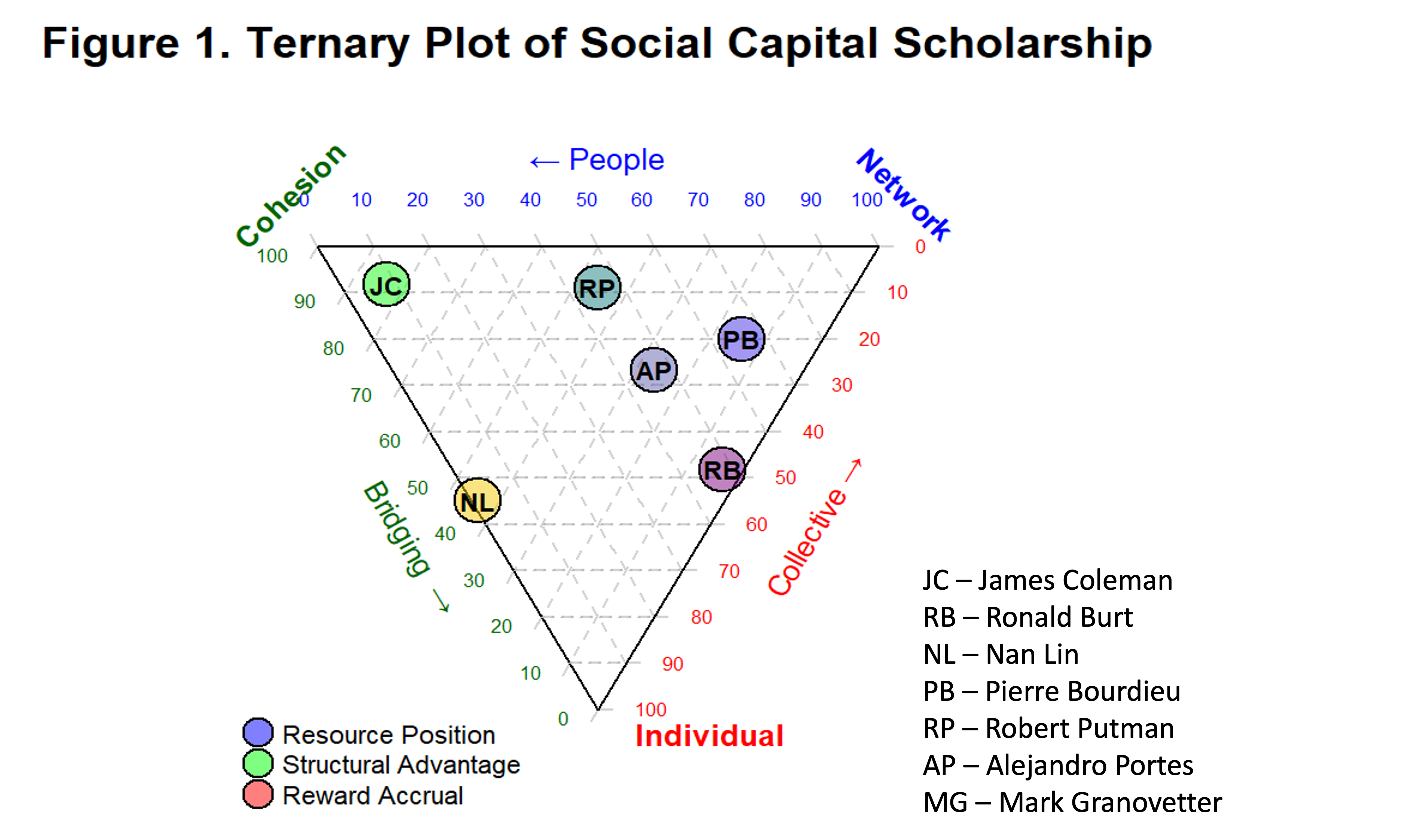
The idea is that this dimensionalizing helps identify–when seeming gaps/contradictions arise, whether that’s based in differential emphases across the combination of those dimensions or actual disagreements arising from any of them; more often seemingly arising from the former than the latter (e.g., different assumptions/variations on one dimension altering expectations on another).
We hope this provides a more systematic framework for putting the pieces back together (or disambiguating them into their constituent parts more intentionally), & points a way forward that doesn’t “throw up our hands” assuming SC’s having meant too many different things makes it unsalvageable.