
(a place to gather some less formal “ideas in process” writings)
October 24, 2026
a fresh restart
I had a regular blogging habit for well over a decade. It was incredibly helpful to my engaging writing as a practice, not just a product.
Read more
So, I’m trying to make that part of my regular activities again. This is one of the places I intend to re-engage that form of writing.
Who knows, occasionally some of this might be useful for things beyond trying to help me improve my own writing. But for now, it’s at least a renewed commitment to that.
For now, I’m populating this page with some old social media threads announcing a few papers.
July 2, 2026
ethics in networks research
New resource - article and accompanying site that I contributed to. The site includes an executive summary intended for sharing with IRBs for facilitating networks research.
I’m super excited to have this out. The team was great to work with!
Read more
Now a bit of (self-indulgent?) back story. In my little green book’s section on ethics, I mused that maybe someday, someone could help consolidate the seeming wild west of ethical approaches to network research that exist in the field.
“…given the highly multidisciplinary and interdisciplinary nature of social networks research, it is unclear which organization(s) would take the lead in that charge. Perhaps the International Network for Social Network Analysis (INSNA) and the Network Science Society could support a joint effort toward the development of such standards. However, the members of those two organizations come from many dis- ciplines, which may make that aim especially difficult; the ethical codes already present across those varied disciplinary professional associa- tions may not be easily aligned under a single umbrella. This leaves as an open question how viable it may be to arrive at a single code of ethics for social network researchers…”
When I joined the INSNA board, I inquired about them doing so. The response was essentially “that sounds great; wanna organize?” Whoops.
So a few years ago, I started sending out requests to folks I thought would be important to be involved and might be interested. After a few iterations a team assembled and we started pulling things together.
One of our resolute aims was to distill what’s out there, not to create new standards, and hopefully in doing so, to provide a central resource to help smooth the process for researchers dealing with IRBs who just don’t have a mental map for how to deal with the needs of social network research.
As we neared being able to pull things into an actual paper, I hit a personal/professional wall, and the project stalled because of me for a while (sorry team!). Eventually I had the wherewithal to ask others on the team to take the lead and see it through. And did they ever! Francisca Ortiz Ruiz , José Luis Molina, & Paola Tubaro in particular took the lead, clarified the work the team had already done, got it into a coherent form, turned it all into an actual paper rather than a collection of ideas, and pushed things over the line. I’m so happy they did so!
As with the initial intent, we hope this is a useful resource for people who are trying to get network research done.
December 3, 2024
unifying social capital
Our ARS paper w/ Paulina Erices-Ocampo & Miranda Lubbers) on social capital is now published.
Over the years, I was shocked by the number of consulting requests I’d get as a social network scholar that assumed all of us study social capital; I didn’t. However, in an attempt to expedite some of those conversations, I ultimately came up with a “distillation” of how I saw the “lay of the land.”
Read more
This sat in a slide deck, and got tweaked from time to time over the course of a number of years. Most of these revisits came when one of those requests were attempting to leverage the idea of social capital in ways that I saw as pretty incompatible with the (primary) theorist(s) being cited.
So, it became a question for me of how disjointed the field’s organization actually was, something we took a quick pass at in a visualization piece last year w/ Kate Fitch, and whether there was a real way to fit those pieces together into a meaningful whole.
When (an advisee) Paulina’s dissertation started heading deeper into this territory, I decided that maybe this framework had something to offer, but worried about not being an actual social capital scholar myself, & the potential to say something really stupid if I wasn’t careful.
I asked Miranda if she’d join us in this effort; her being someone squarely in that space, and who: I trusted would point out anywhere I was really off base, knows the nuances of many of the literatures we needed to engage with, and is generally someone I just enjoy writing with.
We pitched to ARS, w/ Paulina keeping the engine moving, and ultimately submitted the paper attached here. The basic premise is that there are 3 primary dimensions along which previous conceptualizations of social capital vary:
- where beneficial resources reside (in individuals or relationships);
- what network patterns optimize the deployment of those resources (cohesive or structural hole arrangements); and
- to what level benefits primarily accrue (individual or collective).
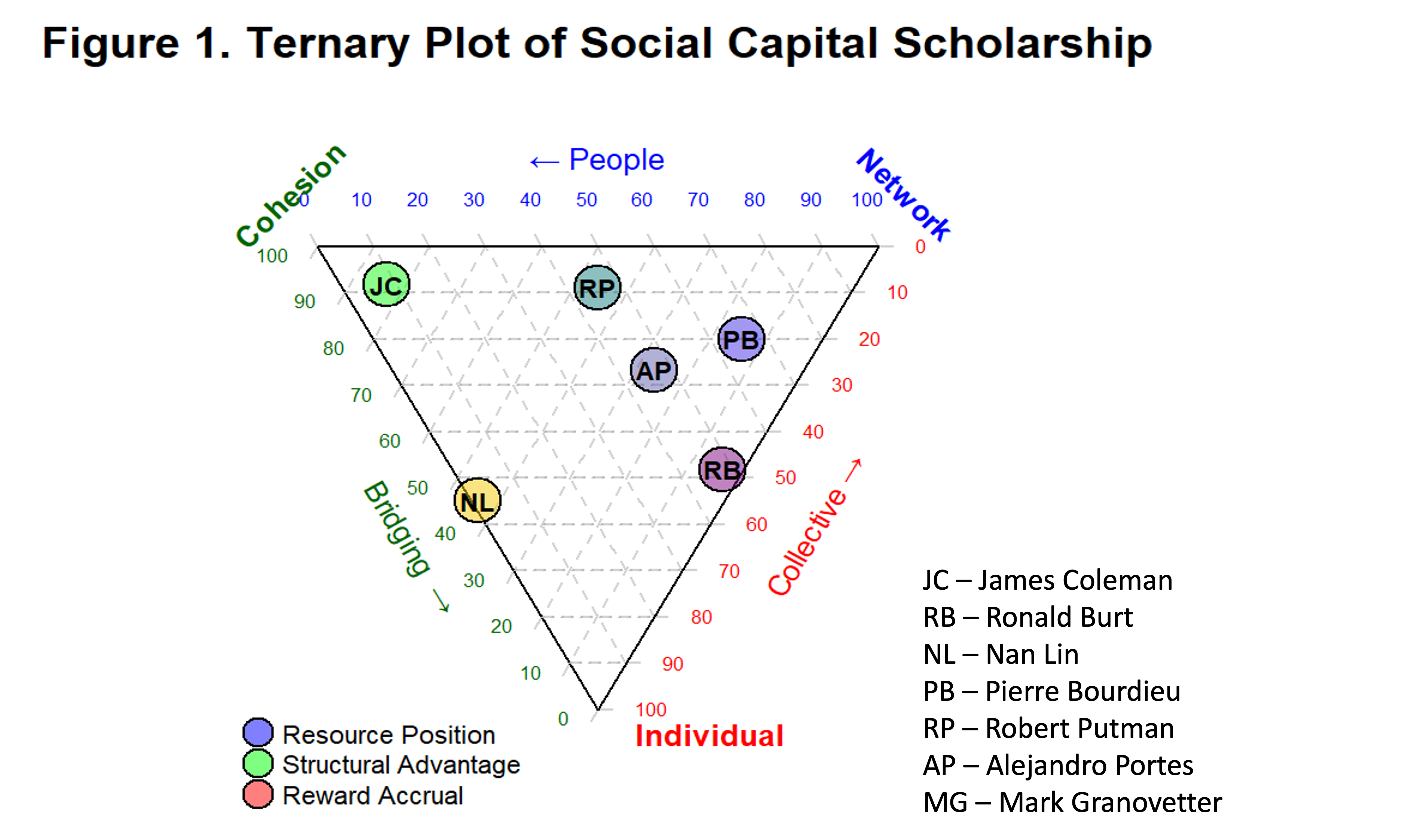
The idea is that this dimensionalizing helps identify–when seeming gaps/contradictions arise, whether that’s based in differential emphases across the combination of those dimensions or actual disagreements arising from any of them; more often seemingly arising from the former than the latter (e.g., different assumptions/variations on one dimension altering expectations on another).
We hope this provides a more systematic framework for putting the pieces back together (or disambiguating them into their constituent parts more intentionally), & points a way forward that doesn’t “throw up our hands” assuming SC’s having meant too many different things makes it unsalvageable.
September 23, 2024
NBA trades
A new paper w/ Michał Bojanowski is now published in Network Science.
In it we examine the popular refrain that NBA teams avoid trading with others within their own division. The paper also serves as a bit of a tutorial for the logic of when a weighted exponential random graph model is necessary.
If I’d had the gumption we’d have followed my suggestion that papers w/ Yes/No questions for titles should have one word abstracts. In this case, that would have been “No.”
Read more
This paper started as an aside comment in a grad class a number of years ago. Several years later, early 2020 in fact, a student in that course reached out to say he’d scraped the data I’d need to answer that question. While Michał and I started this around then intending it as a simple visualization (e.g., slice below), given covid & covid work, it quickly got back-burnered.
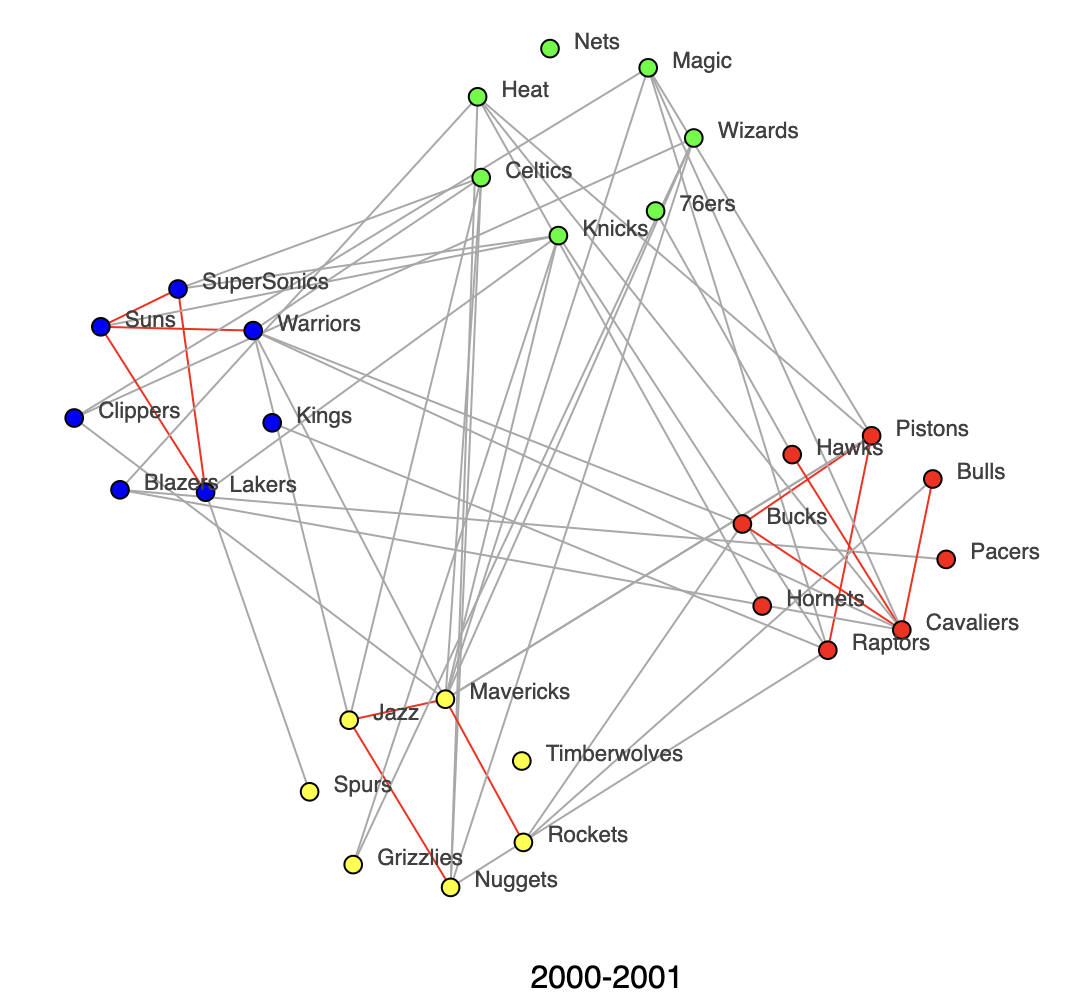
The catch is the question actually requires proper conditioning of the question statistically (to account for the base trade rate opportunities’ divergence from random “preferences” & the weighted nature of the data) to be answered accurately. We demonstrate how easy it would be to come to the wrong conclusion in the paper.
So it took on a bit of a larger life than the initial visualization plan, and took longer than anticipated to get out. But it’s up now. We also posted our data & code (https://github.com/mbojan/nba-trades), not just for “Open Science” reasons, but also because there are a LOT of related ways to extend our question into analyses about actual trade predictors that could make use of those. Hopefully someone will take those and run with them.
Ungated version - https://mbojan.github.io/nba-trades/
February 1, 2023
multiplex contagion
A couple of weeks ago, a recent paper w/ Nicholas Landry appeared in PLoS One.
Here, I’m dusting off (and revising slightly) an old thread from
Read more
Some years ago, I noticed an apparent growing trend of increasing precision, about (narrower?) behaviors/relationships in network data collection, (especially in studies of STIs - e.g., studies of sex OR needle sharing).
Yet, when writing my “little green book” on network data collection, I became more and more intrigued by the fact that social network analysis initially was very multiplex in focus, and the focus on single ties at a time really came later. I definitely think there are benefits to this focus (e.g., the need for domain expertise to improve data quality, etc.). But I also recognize that some of the ways such data are used don’t always consistently match-up to the theoretical topics of interest.
The aim was to demonstrate when this “decomposed” data approach “adds up” to the full process of interest, and when it does not. But, I had way too many irons in the fire, so I back-burnered the idea, hoping to loop back at some point.
After encountering a talk & paper by Nicholas, I thought we could make my paper idea happen. I reached out to see if he’d be interested. He was, and took the lead from there.
So the paper:
- takes a multiplex network & simulates a diffusion process over it, then
- decomposes that network into its uniplex layers & runs a diffusion process over each of those separately, then
- compares the union of simulations in (2) to the results in (1).
Bottom line RQ: If we put these constituent pieces (as are available from studies of each tie type separately) back together, do we “recover” the full diffusion extent?”
We do this separately for:
- a behavioral network w/ a “simple” contagion process (i.e., an STI), and
- an (online) social network for a “complex” contagion process (i.e., “an idea”). (Here, think of studying ideas spreading, but focusing on a single platform at a time.)
We find that combining the results from the 2 uniplex network contagion processes doesn’t align w/ their respective multiplex networks. In the simple contagion, the union epidemic extent is LESS than for the corresponding multiplex network. In the complex contagion, the union diffusion extent is GREATER than for the corresponding multiplex network.
I see the big takeaway as we should reconsider whether this focus on data precision is an appropriate tradeoff for our theoretical aims.
Code & links to obtain data used are available here.
Thanks again to Nicholas Landry for pulling this out of my “file drawer” and leading it to the light of day.